
Enterprise Agentic AI Governance: Why AI Agents Fail Before Production
Most enterprise AI agents do not fail at the demo stage. They fail when production asks harder questions about business value, cost, accountability, permissions, observability, and governance.
Written By: Chakravarthy Varaga
Agentic AI does not usually fail in the demo.
It fails when the organization asks production questions.
A demo can make an AI agent look impressive. It can retrieve information, summarize documents, call tools, draft responses, and complete simple tasks across systems.
But production asks something different:
- What business value is this actually delivering?
- What does it cost when usage scales?
- What systems can it access?
- What actions can it take?
- Who approves those actions?
- Who is accountable when it makes the wrong move?
- How do we know whether it is improving or degrading over time?
These are not secondary questions.
They are the operating model.
This is why many enterprise agentic AI programs will struggle before production. The issue is not that AI agents have no value. The issue is that many organizations are scaling autonomy faster than they are scaling accountability.
Key Takeaway
Enterprise agentic AI is not just a model capability. It is an operating model shift. If the governance layer is weak, the project will eventually fail no matter how impressive the demo looks.
The issue is not agentic AI. The issue is unmanaged autonomy.
Agentic AI is powerful because it can move beyond simple chat.
It can reason through a task, use tools, interact with systems, and take action. Platforms such as Amazon Bedrock Agents, Microsoft Azure AI Foundry, Google Vertex AI Agent Builder, Salesforce Agentforce, and ServiceNow AI Agents are all moving enterprises toward systems that can coordinate work across business applications.
That is exactly why production governance matters.
An enterprise AI agent is not just another chatbot interface. Once it can call tools, touch records, create tickets, route approvals, or influence customer and employee workflows, it becomes part of the operating layer of the business.
The question is no longer only:
Can the model answer correctly?
The question becomes:
Can the system act safely, reliably, and accountably inside the enterprise?
That is a much higher standard.
Not every AI workflow needs an agent
One of the first mistakes enterprises make is treating every AI use case as agentic.
That usually leads to unnecessary complexity.
In practice, enterprise AI workflows tend to fall into three broad patterns: assistant, automation, and agent. These patterns are related, but they are not the same.
| Pattern | What it does | Typical enterprise examples | Risk level |
|---|---|---|---|
| Assistant | Retrieves, summarizes, explains, and points users to the right source. | HR policy lookup, IT knowledge search, sales account summaries, finance policy explanation. | Low to moderate |
| Automation | Executes repeatable steps where rules are clear and predictable. | Ticket creation, approval routing, reminder notifications, status updates. | Moderate |
| Agent | Interprets a request, makes decisions, calls tools, and takes action across systems. | Access request triage, sales follow-up orchestration, invoice exception handling, support resolution workflows. | Higher |
If the user only needs information, build an assistant.
If the process is predictable, build automation.
If the workflow requires judgment, system access, exception handling, and action, then an agent may be justified.
This distinction matters because every level of autonomy increases the need for permissions, traceability, approval design, observability, exception handling, cost control, and business ownership.
Where enterprise AI agents make sense
Agentic AI creates the most value when work is fragmented across systems, teams, and decisions.
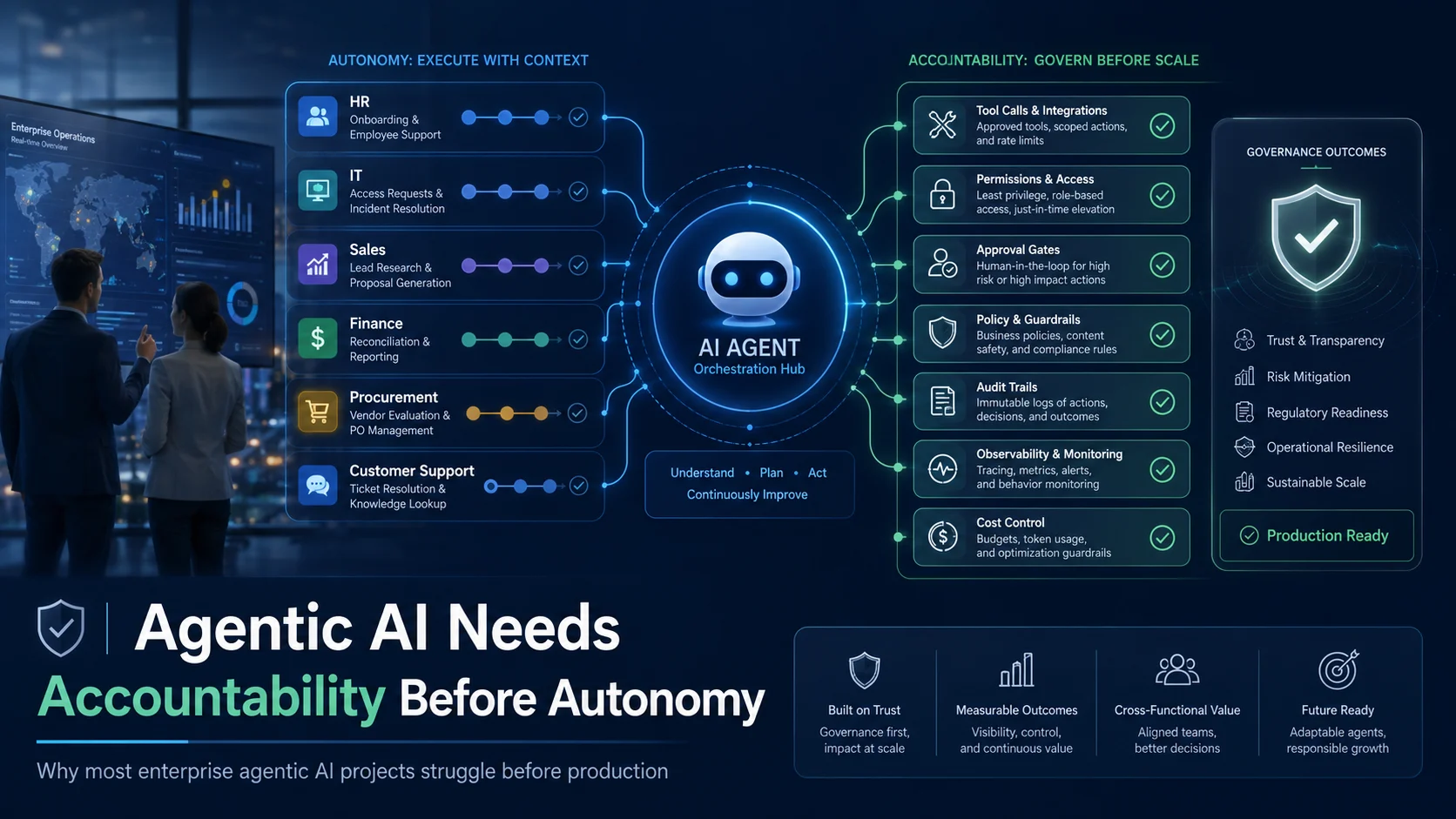
That is why the strongest enterprise use cases usually sit inside real operating functions: HR, IT, sales, finance, procurement, customer support, and compliance.
| Department | Potential agentic workflow | Business value | Governance concern |
|---|---|---|---|
| HR | Employee service request triage, eligibility checks, case preparation. | Faster employee support and reduced manual coordination. | Access to employee records, policy exceptions, sensitive data. |
| IT | Access request triage, incident classification, ticket routing. | Reduced helpdesk load and faster issue resolution. | Identity, permissions, privileged access, security approvals. |
| Sales | CRM follow-up, account research, next-best-action recommendations. | Better sales hygiene, improved follow-through, faster account preparation. | Customer communication, forecast changes, commercial commitments. |
| Finance | Invoice exception review, expense policy checks, reconciliation support. | Lower manual review effort and faster exception handling. | Payment approvals, vendor data, financial controls. |
| Procurement | Vendor request intake, approval routing, document completeness checks. | Faster procurement cycles and better request quality. | Vendor onboarding, spend thresholds, legal/security reviews. |
| Customer Support | Ticket classification, context retrieval, response drafting, escalation support. | Faster response times and improved support productivity. | Refunds, account changes, legal-sensitive communication. |
| Compliance | Policy lookup, evidence collection, exception tracking, audit preparation. | Improved traceability and faster compliance operations. | Auditability, source reliability, regulatory exposure. |
These examples are useful because they show where agentic AI can help. But they also show why agentic AI cannot be treated as a generic productivity layer.
Each workflow has a different risk profile. Each system has different permissions. Each department has a different accountability model.
That is why enterprise AI agents need governance before scale.
Planning an enterprise AI agent initiative?
C4Scale helps teams evaluate agentic AI opportunities, define the right workflow architecture, and design production-ready governance before autonomy is scaled.
Talk to C4Scale about Agentic AI ReadinessThe action surface matters more than the prompt
In production, the most important question is not:
What can the agent say?
The more important question is:
What can the agent do?
That is the action surface.
The action surface defines what systems, tools, data, and business actions an AI agent can access.
For example:
- An HR agent may answer policy questions, but should it read compensation data?
- An IT agent may create tickets, but should it grant access?
- A sales agent may draft follow-ups, but should it change forecast values?
- A finance agent may flag invoice exceptions, but should it approve payment?
- A procurement agent may prepare vendor workflows, but should it approve onboarding?
These are not prompt questions.
They are architecture, security, and governance questions.
This is why enterprise teams increasingly need to think about AI agents alongside identity and access systems such as Microsoft Entra ID, enterprise service workflows such as ServiceNow, CRM systems such as Salesforce, HR systems such as Workday, and observability standards such as OpenTelemetry.
The agent does not live in isolation.
It lives inside the enterprise operating environment.
Accountability must come before autonomy
A useful enterprise AI agent should not start with broad autonomy.
It should earn autonomy gradually.
| Maturity stage | What the agent can do | Typical enterprise use | Control expectation |
|---|---|---|---|
| Read-only assistance | Retrieve, summarize, explain, and recommend. | Policy lookup, account summary, knowledge retrieval. | Source citation, access control, quality review. |
| Drafted actions | Prepare responses, tickets, tasks, or updates. | Draft customer replies, create HR case drafts, prepare sales follow-ups. | Human approval before execution. |
| Approved actions | Execute defined actions after explicit approval. | Submit access requests, update ticket states, route procurement items. | Approval logs, audit trails, role-based permissions. |
| Limited autonomy | Execute low-risk, reversible actions inside defined boundaries. | Notifications, task creation, routing, status updates. | Monitoring, thresholds, rollback, exception alerts. |
For most enterprise workflows, the highest early value is not full autonomy.
It is better decision support, faster coordination, and reduced operational friction.
The goal should not be to remove humans from every workflow.
The goal should be to put human judgment in the right places.
Production readiness requires more than prompt engineering
Prompt engineering can improve agent behavior. But it cannot replace the production infrastructure required to make an agent reliable, safe, and measurable.
Production-ready enterprise AI agents need a governance layer that spans the full operating context. That typically includes:
- Tool calls and integrations — approved tools with scoped actions and defined rate limits.
- Permissions and access — least-privilege access, role-based controls, just-in-time elevation where needed.
- Approval gates — human-in-the-loop checkpoints for high-risk or high-impact actions.
- Policy and guardrails — business policies, content safety filters, and compliance rules enforced at runtime.
- Audit trails — immutable logs of what the agent did, what it decided, and what resulted.
- Observability and monitoring — tracing, metrics, alerts, and behavior monitoring in production.
- Cost control — budgets, token usage limits, and optimization guardrails to prevent runaway spend.
This is the accountability infrastructure that makes agentic AI safe to operate at scale.
Business value must be measurable from the start
One of the most common failure patterns in enterprise agentic AI is that value is assumed rather than measured.
A workflow gets automated. Activity metrics go up. But the business outcomes that actually matter — time saved per case, reduction in escalations, improvement in resolution rates, cost per completed workflow — are never defined and never tracked.
Without measurable outcomes, agentic AI programs become hard to defend when costs rise, issues emerge, or stakeholders ask harder questions.
The fix is simple but requires discipline. Before building, define what success looks like in terms that the business cares about. What is the current baseline? What is the target? How will improvement be measured?
This prevents teams from scaling workflows that feel impressive but do not produce durable business value.
The real enterprise challenge is ownership
Agentic AI cuts across business and technology.
That makes ownership complicated.
An HR agent is not only an AI project. It is an HR operating model project.
An IT access agent is not only a technology project. It is an identity, security, and service-management project.
A finance exception agent is not only an automation project. It is a governance, approval, and auditability project.
A sales agent is not only a productivity tool. It affects CRM quality, customer communication, forecasting, and revenue process discipline.
This is why enterprise agentic AI cannot be owned only by innovation teams.
It needs shared ownership across business process owners, technology leaders, security teams, data teams, compliance teams, and operations leaders.
Without ownership, accountability becomes unclear.
And when accountability is unclear, production adoption slows down.
Why many agentic AI projects will be canceled
Many agentic AI projects will not be canceled because the technology does not work.
They will be canceled because the organization cannot prove:
- the value is real,
- the cost is controlled,
- the workflow is reliable,
- the action surface is safe,
- the system is observable,
- the risk is governed,
- and the ownership model is clear.
That is the production test.
Enterprises that pass this test will move beyond AI demos and build durable operating systems around agents.
Enterprises that fail this test will keep building impressive prototypes that stall when production asks harder questions.
A better way to think about enterprise AI agents
Enterprise agentic AI should not begin with the ambition to automate everything.
It should begin with a disciplined question:
Where can AI safely improve a real business workflow with measurable value?
That question forces the right conversations.
It forces teams to define the workflow, understand the data, clarify permissions, identify approval points, measure outcomes, and build accountability before autonomy.
That is the shift required.
Build accountable AI agents before scaling autonomy
C4Scale helps enterprises move from AI demos to production-ready agentic systems by aligning strategy, architecture, governance, integrations, and measurable business outcomes.
Discuss your Agentic AI roadmap with C4ScaleFrequently Asked Questions
What is agentic AI in enterprise systems?
Agentic AI refers to AI systems that can interpret goals, use tools, interact with enterprise systems, and take actions within a workflow. Unlike a basic assistant, an AI agent may participate in business processes such as ticket routing, CRM updates, access requests, invoice exception handling, or customer support triage.
Why do agentic AI projects fail before production?
Many projects fail because teams cannot prove business value, control cost, define accountability, manage permissions, observe behavior, or govern actions safely. The demo may work, but production requires repeatability, traceability, risk control, and ownership.
What is AI agent governance?
AI agent governance is the set of controls that define what an agent can access, what it can do, which actions need approval, how its behavior is monitored, how risks are managed, and who owns outcomes when the agent acts.
How should enterprises start with agentic AI?
Enterprises should start with one bounded workflow where the business value is clear and the action surface can be controlled. The safest path is usually read-only assistance first, then drafted actions, then approved actions, and only later limited autonomy.
What is the difference between an AI assistant and an AI agent?
An AI assistant usually retrieves, summarizes, or explains information. An AI agent can make decisions, call tools, and take action across systems. That additional autonomy makes agent governance, permissions, observability, and approval design much more important.
Which enterprise functions can use AI agents?
AI agents can support HR, IT, sales, finance, procurement, customer support, compliance, and operations. The strongest use cases usually involve workflows where information is spread across systems, decisions require context, and teams spend time coordinating repetitive work.
What should enterprises measure in production AI agents?
Enterprises should measure successful task completion, tool-call correctness, escalation rates, human approval rates, unsafe action attempts, latency, cost per completed business outcome, and user trust. The goal is not just model accuracy, but reliable workflow performance.
Final thought
The future of enterprise agentic AI will not be decided by who builds the most autonomous agent.
It will be decided by who builds the most accountable one.
Autonomy without accountability creates risk.
Accountability without execution creates bureaucracy.
The right architecture sits between the two.
It gives agents enough capability to create value, and enough governance to make that value safe, measurable, and scalable.
That is where agentic AI becomes useful.
Not when it sounds autonomous.
When it becomes production-ready.