
Impact & Results
Analysis Time
Extraction Accuracy
CARO Coverage
Application Throughput
Client Context & Problem
A B2B FinTech company that sells AI-powered credit analysis tools to banks and financial services companies. Their analyst teams evaluate SME borrower credit worthiness by reviewing annual reports, audited financials, and regulatory filings — and were spending 2–3 days per application on manual extraction. With growing client demand, this bottleneck was limiting their ability to scale.
Pain Points
- Annual reports arrive as scanned PDFs, image-heavy filings, and mixed-format documents
- Critical data — balance sheets, P&L, auditor notes — buried across 80–200 page documents
- Manual extraction took 2–3 analyst days per application
- Inconsistent extraction quality led to credit decision errors
- CARO audit observations and management commentary missed in time-pressured reviews
- No structured output for downstream credit scoring models
Key Challenges
Document heterogeneity
Annual reports from hundreds of companies had no consistent format — scanned images, native PDFs, multi-column layouts, handwritten annotations
Financial table extraction
Balance sheets and P&L statements span multiple pages with merged cells, footnotes, and restated comparatives
Regulatory nuance
CARO observations, going-concern qualifications, and auditor exceptions required contextual LLM reasoning — not just OCR
Validation at scale
Extracted figures needed cross-validation against accounting identities (Assets = Liabilities + Equity) before surfacing to analysts
Multi-cloud constraints
Client had existing investments in both AWS and Azure — the platform needed to bridge both environments
Project Goal
Reduce credit analysis time from 2–3 days to under 30 minutes per application by automating document ingestion, financial data extraction, validation, and insight generation — while preserving analyst control over final decisions.
Success Metrics
- Process any annual report format in under 30 minutes
- Extract 95%+ of key financial line items accurately
- Surface CARO, auditor, and management insights automatically
- Validate extracted data against accounting identities before delivery
- Provide structured output consumable by credit scoring models
Solution & Architecture
We built a five-stage GenAI pipeline on AWS + Azure: an Ingestion & OCR stage pre-processes all document formats using AWS Textract for scanned content and Azure Document Intelligence for native PDFs; an Extraction Agent applies multimodal LLM inference to pull structured financials — balance sheet, P&L, cash flow statement — with line-item confidence scores; a Validation Agent cross-checks extracted figures against accounting identities and flags anomalies; an Insights Agent reads auditor opinions, CARO observations, management commentary, and related-party disclosures to generate structured risk signals; and a Credit Analyst View delivers a consolidated workspace where analysts review structured data, AI-generated insights, and source evidence side by side.
Architecture
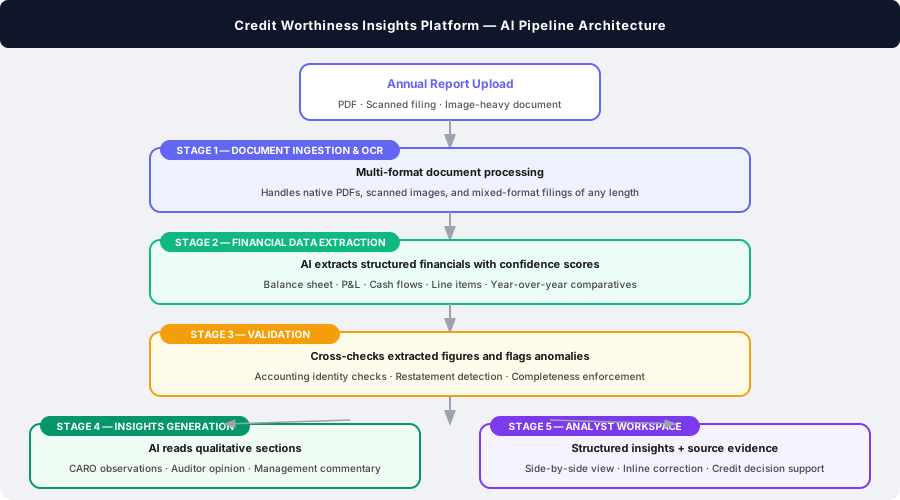
Five-stage GenAI pipeline on AWS + Azure: OCR/Ingestion → Financial Extraction → Validation → Insights Generation → Analyst Workspace
Key Components
- Ingestion & OCR Layer — AWS Textract for scanned documents, Azure Document Intelligence for native PDFs, page classification and layout detection
- Financial Extraction Agent — multimodal LLM extracts balance sheet (assets, liabilities, equity), P&L (revenue, EBITDA, PAT), and cash flow statement with per-line confidence scores
- Validation Agent — cross-validates extracted figures against accounting identities, detects restatements, flags year-over-year anomalies, and enforces extraction completeness
- Insights Agent — reads auditor opinion, CARO observations, going-concern qualifications, management commentary, and related-party disclosures; generates structured risk signals
- Management Details Extractor — identifies directors, key managerial personnel, ownership structure, and changes in promoter holdings from regulatory filings
- Credit Analyst Workspace — side-by-side view of source document page and structured extracted data; inline correction with feedback loop into eval harness
- Structured Output API — delivers validated financials and risk signals in JSON schema compatible with downstream credit scoring models
Workflow
Document Ingestion
Annual report uploaded (PDF, scan, or image); page classifier identifies document type and routes to AWS Textract or Azure Document Intelligence for OCR
Financial Extraction
Financial Extraction Agent applies multimodal LLM inference to extract balance sheet, P&L, and cash flow statement with per-line confidence scores and source page references
Validation
Validation Agent cross-checks figures against accounting identities (Assets = Liabilities + Equity), detects year-over-year restatements, and flags anomalies before surfacing to analysts
Insights Generation
Insights Agent reads auditor opinion, CARO observations, going-concern qualifications, management commentary, and related-party disclosures — generating structured risk signals with evidence citations
Analyst Review
Credit Analyst View presents source document alongside extracted structured data; analysts can correct inline, and corrections are logged for eval harness improvement
Structured Output
Validated financials and risk signals delivered via JSON API to downstream credit scoring models; full audit trail maintained per application
Analyst Experience
Before
2–3 analyst days per application: manually reading 80–200 page PDFs, extracting tables into spreadsheets, and writing credit summaries
- •Download annual report PDF
- •Manually scan through 80–200 pages
- •Copy balance sheet, P&L, cash flow into spreadsheet
- •Read auditor opinion and CARO section manually
- •Draft credit summary — high error risk under time pressure
- •2–3 days per application
After
Under 30 minutes per application: structured financials, auditor insights, and risk signals pre-populated; analyst reviews and approves
- •Upload annual report — any format
- •AI extracts all financial statements with confidence scores
- •CARO, auditor, and management insights auto-generated
- •Validation flags anomalies before analyst sees data
- •Side-by-side view: source page + extracted structured data
- •Under 30 minutes per application
Why C4Scale
Document AI expertise
Deep experience with multimodal LLMs, AWS Textract, and Azure Document Intelligence for complex financial document extraction
Financial domain knowledge
Understanding of accounting identities, CARO regulations, and Indian/global audit standards required to build accurate validation logic
Multi-cloud architecture
Bridged existing AWS and Azure investments without forcing migration — each service runs where it performs best
Human-in-the-loop design
Built the analyst workspace and feedback loop so AI augments — not replaces — credit analyst judgment
Production-grade validation
Accounting identity cross-checks and anomaly detection ensure analysts receive validated data, not raw LLM output
Ready to transform your operations?
Let's discuss how C4Scale can help you achieve similar results