
Impact & Results
Development Time
Team Size
Model Capability
Market Differentiation
Client Context & Problem
An EdTech company wanted to help students memorise long chapters by compressing them into single images. Given a few keywords, the model would generate a custom, kid-friendly illustration encoding the entire chapter.
Pain Points
- Creating glyph-like, cartoonish images that capture chapter content
- Building a training dataset (labelled images and text) from scratch
- Combining multiple model architectures (CNNs, RNNs, GANs, Stable Diffusion, YOLO)
- Ensuring safe outputs for educational content
Key Challenges
Multimodal complexity
Combining CV, NLP and generative models into cohesive pipeline
Training data
Building labelled image/text pairs from scratch for curriculum
Quality & safety
Ensuring kid-friendly, educationally appropriate outputs
Timeline & resources
Deliver in 5 months with team of ~10 people
Project Goal
Deliver a text-to-image model that can be tuned for educational content, with high-quality outputs, in under 5 months using a small team of about 10 people.
Success Metrics
- Generate kid-friendly, glyph-like images from keywords
- Capture chapter content in single mnemonic visual
- Deliver working model in under 5 months
- Safe, educationally appropriate outputs
Solution & Model Architecture
We built a synthetic data pipeline on AWS to generate labelled image/text pairs, then trained a CNN-RNN-GAN stack augmented by Stable Diffusion and YOLO modules. The pipeline produced creative, gliphy images matching input keywords. Stable diffusion layers handled style transfer, while YOLO validated object placement. A lightweight UI allowed teachers to customise prompts and review outputs.
Architecture
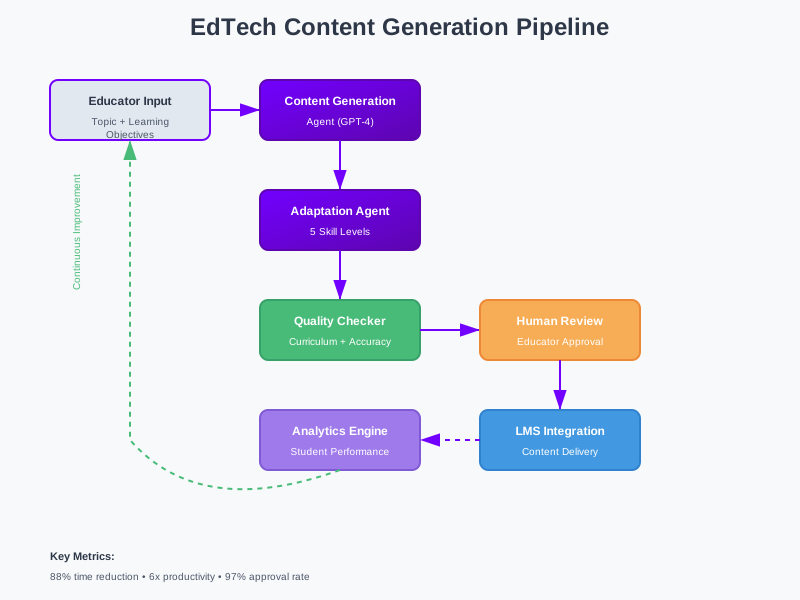
CNN-RNN-GAN stack with Stable Diffusion and YOLO modules, synthetic data pipeline, and teacher review UI
Key Components
- Synthetic data pipeline for labelled image/text pairs
- CNN-RNN-GAN architecture for image generation
- Stable Diffusion modules for style transfer
- YOLO modules for object placement validation
- RNN-based text encoding for keyword processing
- Teacher review UI for prompt customization
- API deployment for LMS integration
Workflow
Data collection
Collect and label text-image pairs from curriculum
Image generation
Use GAN + Stable Diffusion models to generate candidate images
Object validation
Use YOLO models to enforce key object presence
Fine-tuning
Fine-tune the generator with RNN-based text encodings
Review
Present candidates to the review team
Deployment
Deploy the model behind an API for integration into the learning platform
User Experience
Before
Students struggled to memorize long text chapters; teachers had no tools to create visual mnemonics
- •Students read long text chapters
- •Limited visual aids available
- •Memory retention was low
- •No automated way to create custom mnemonics
After
Teachers select a chapter, provide keywords, and receive a colourful, cartoonish image capturing the main points. Students recall the chapter more easily using mnemonic visuals.
- •Teacher selects chapter and provides keywords
- •AI generates kid-friendly, glyph-like image
- •Image captures key chapter concepts
- •Students use visual mnemonics for recall
- •Memory retention improves significantly
Why C4Scale
Multimodal expertise
One of the few firms that can combine CV, NLP and generative models in production
Synthetic data
Built training datasets from scratch using synthetic data pipelines
Lean execution
Solved complex multimodal problem with lean team of ~10
Education domain knowledge
Understood educational content requirements and safety constraints
Ready to transform your operations?
Let's discuss how C4Scale can help you achieve similar results