
Agentic Violation Processing System — U.S. Violation Management Co.
Four named AI agents — Email Classifier, Document Understanding, Data Router, and Validation & Harness — process 1,000+ violation tickets per week with near-zero manual intervention.
Impact & Results
Processing Time
Manual Data Entry
Error Rate
Backlog Visibility
Client Context & Problem
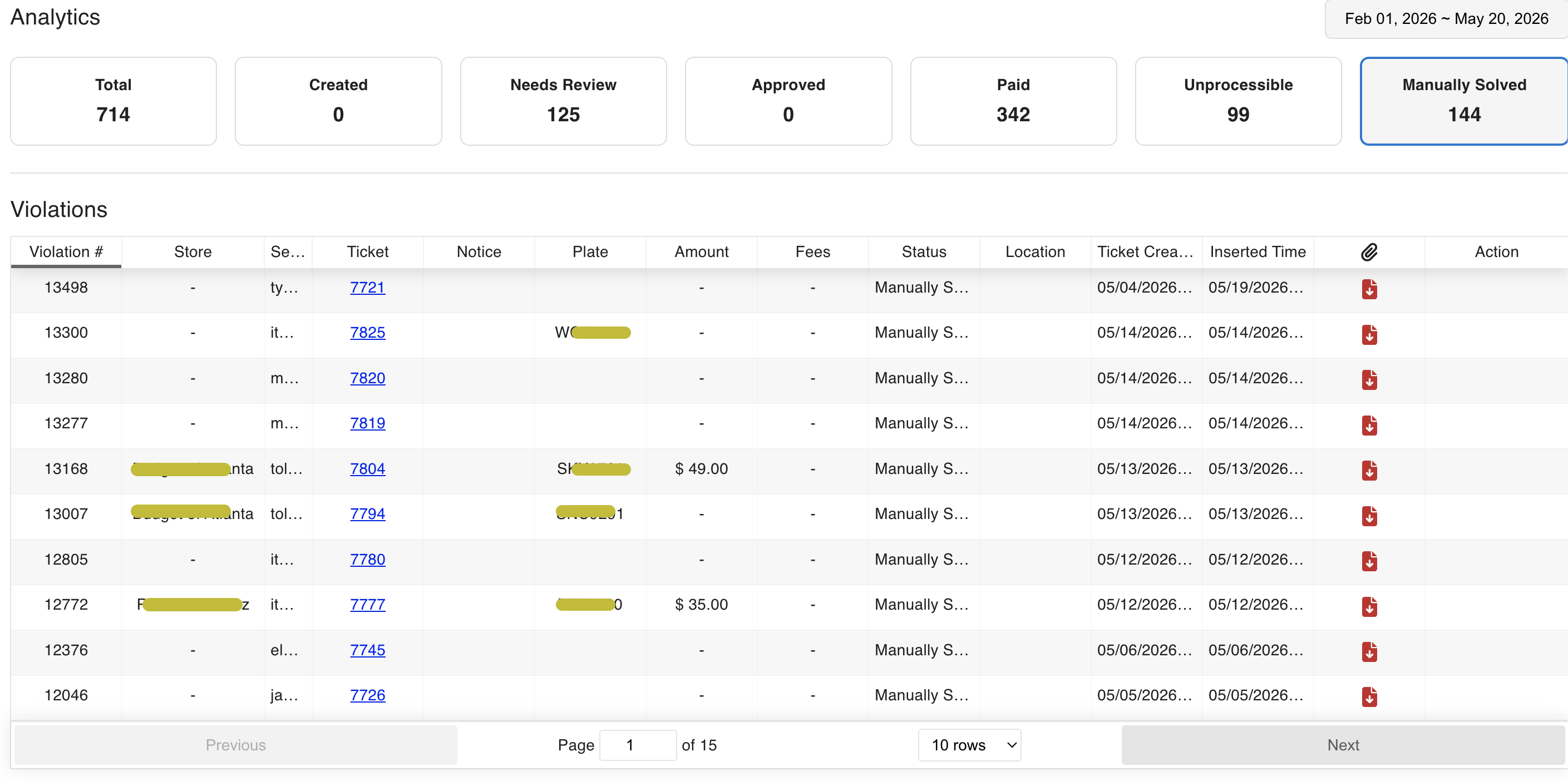
A U.S.-based agency received more than 1,000 violation tickets each week. Staff manually downloaded PDFs, scanned documents and emails from Zendesk and entered details into spreadsheets. Processing was slow, error-prone, and costly.
Pain Points
- Ticket formats varied by city
- Each ticket could contain multiple violations and attachments
- Invoices and payment receipts were mixed in
- Simple OCR tools failed to handle the complex layout
Key Challenges
Variable ticket formats
Ticket formats varied by city; each could contain multiple violations
Complex document structure
Invoices and payment receipts were mixed in; simple OCR tools failed
High volume processing
1000+ tickets per week requiring fast, accurate data extraction
Quality assurance
Need for human review on low-confidence extractions
Project Goal
Eliminate manual data entry, process tickets in minutes instead of days, route edge cases to human reviewers only when needed, and trigger payments automatically.
Success Metrics
- Process 1000+ tickets per week automatically
- Reduce processing time from days to minutes
- Route only low-confidence cases to humans
- Trigger payments automatically
Solution & Agentic AI Workflow
We deployed a four-agent system: an Email Classifier Agent ingests and categorises each Zendesk ticket by type and confidence; a Document Understanding Agent reads PDFs, images, and mixed attachments to extract vehicle details, violation codes, and amounts using multimodal LLM inference; a Data Router Agent evaluates extraction confidence and routes tickets to auto-process or human review; and a Validation & Harness Agent checks totals, detects multi-violation tickets, runs automated eval against known patterns, and triggers the payment gateway on pass. Each agent has a defined scope, tool set, and confidence threshold — not a monolithic script.
Architecture
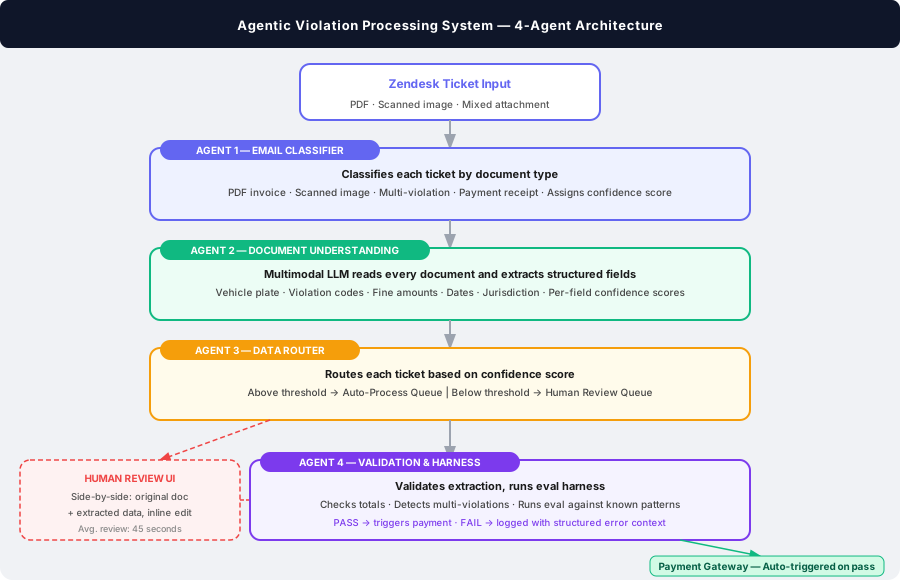
Four-agent system: Email Classifier, Document Understanding, Data Router, and Validation & Harness — each with a defined scope, tool set, and confidence threshold
Key Components
- Email Classifier Agent — ingests Zendesk tickets, classifies by document type (PDF invoice, image scan, mixed), and assigns confidence score
- Document Understanding Agent — multimodal LLM reads each document, extracts vehicle details, violation codes, amounts, and line items with structured output
- Data Router Agent — evaluates per-ticket confidence, routes to auto-process queue or human review queue based on configurable threshold
- Validation & Harness Agent — checks extracted totals against line items, detects multi-violation tickets, runs automated evaluation harness, triggers payment gateway on pass
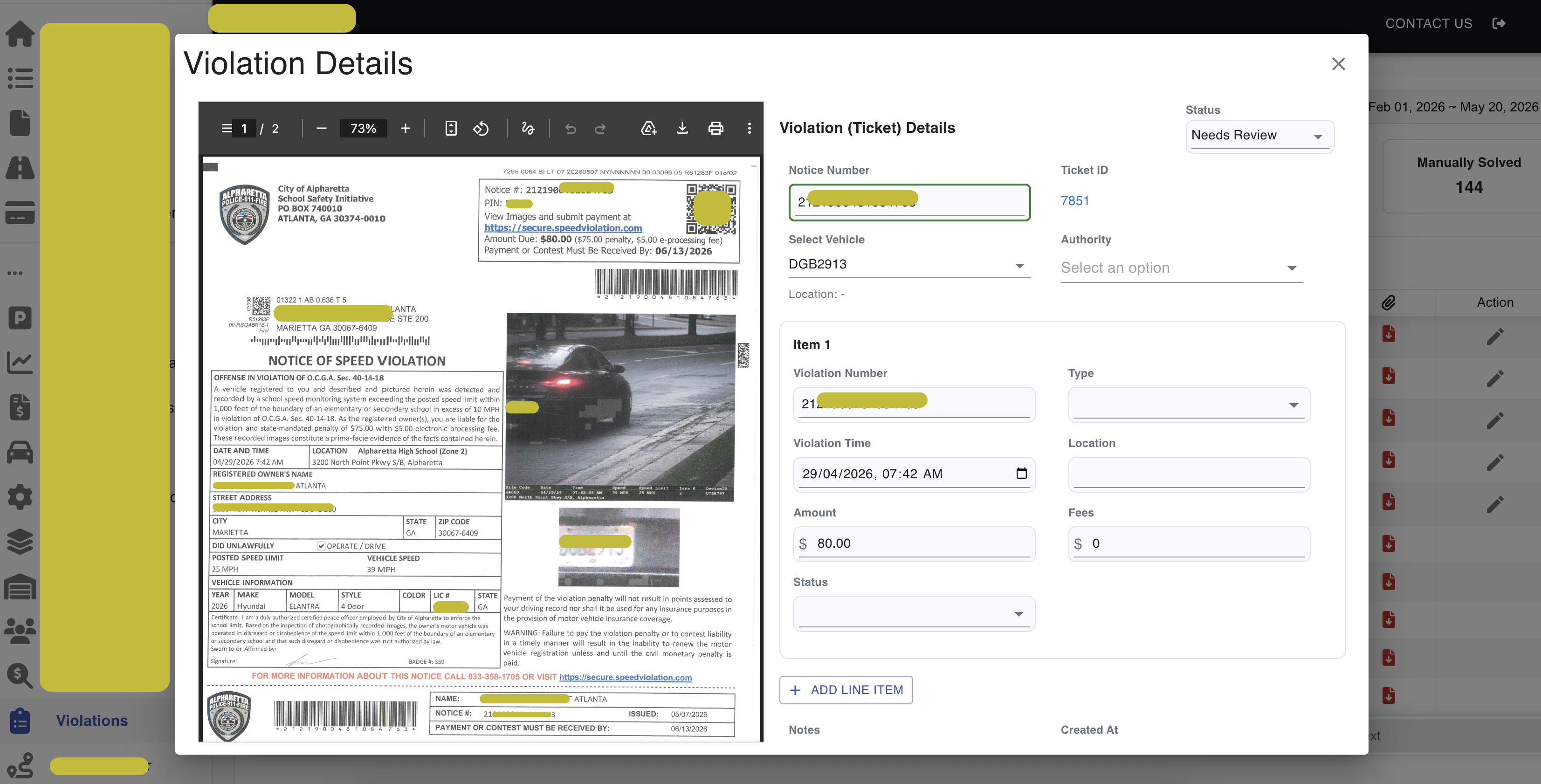
- Human-in-the-loop review UI — side-by-side original document and extracted structured data with inline edit capability for low-confidence cases
Workflow
Ticket Ingestion
Email Classifier Agent pulls from Zendesk API, classifies document type, and scores confidence before passing to the processing queue
Document Understanding
Document Understanding Agent applies multimodal LLM inference to extract vehicle details, violation codes, and amounts — handling PDFs, scanned images, and mixed attachments
Confidence Routing
Data Router Agent evaluates extraction confidence score; tickets above threshold go to auto-process, below threshold route to human review queue
Human Review (edge cases)
Reviewers see original document and extracted data side-by-side with inline edit; corrections feed back into the harness for eval tracking
Validation & Eval
Validation & Harness Agent checks totals against line items, detects multi-violation tickets, and runs automated evaluation against known-good patterns
Payment Trigger
On validation pass, agent triggers payment gateway automatically; failures are logged with structured error context for review
User Experience
Before
Staff manually downloaded PDFs, scanned documents and emails, and entered details into spreadsheets
- •Download PDFs from Zendesk manually
- •Scan through documents to find violations
- •Manually enter vehicle details, codes, and amounts into spreadsheets
- •Calculate totals and reconcile payments
- •Process took days with high error rates
After
Reviewers saw the original document on one side and the structured data on the other, with inline edit capabilities. No more hunting through PDFs.
- •Tickets automatically ingested and processed
- •AI extracts all violation details
- •Side-by-side view: original PDF and extracted data
- •Inline editing for low-confidence cases
- •Processing completed in minutes
Why C4Scale
Business-first AI design
We design AI workflows that fit your business processes instead of forcing you to fit ours
Rapid delivery
Turned a manual, error-prone back office into an AI-run workflow in 30 days
Human-in-the-loop
Built intelligent review queues for edge cases while automating the routine
End-to-end integration
Integrated with Zendesk, payment gateways, and internal systems seamlessly
Ready to transform your operations?
Let's discuss how C4Scale can help you achieve similar results